
Top COB Fine Pitch LED Display Suppliers in China?
Choosing among the top COB fine pitch LED suppliers in China requires more than comparing pixel pitch. It means examining how each display performs under real operating conditions. TrendForce’s LEDinside research and Omdia’s LED Video Displays Market Tracker follow market developments, product categories, and supplier activity. Their findings can help buyers frame comparisons, but report scope and edition matter. Verify figures against the original publication before using them in a purchasing decision.
A 0.9 mm display may look crisp in a showroom, yet reveal uneven color or difficult maintenance in a control room. Ask suppliers for close-up images, measured brightness and uniformity, power data, and a live demonstration. Also inspect a cabinet after repeated handling. Small details count.
As a buyer-side evaluation principle, LED industry analyst Zhang Xiaofei’s market commentary is relevant: “Judge display innovation by application value, not specifications alone.” Treat that sentence as an editorial paraphrase, not a verified verbatim quotation. This distinction matters. Supplier claims should be checked against test methods, warranty terms, and documented project references. A polished demonstration is useful, but it is not independent proof. The comparison that follows focuses on technical fit, production capability, service support, and evidence buyers can verify.
What Is a COB Fine-Pitch LED Display?
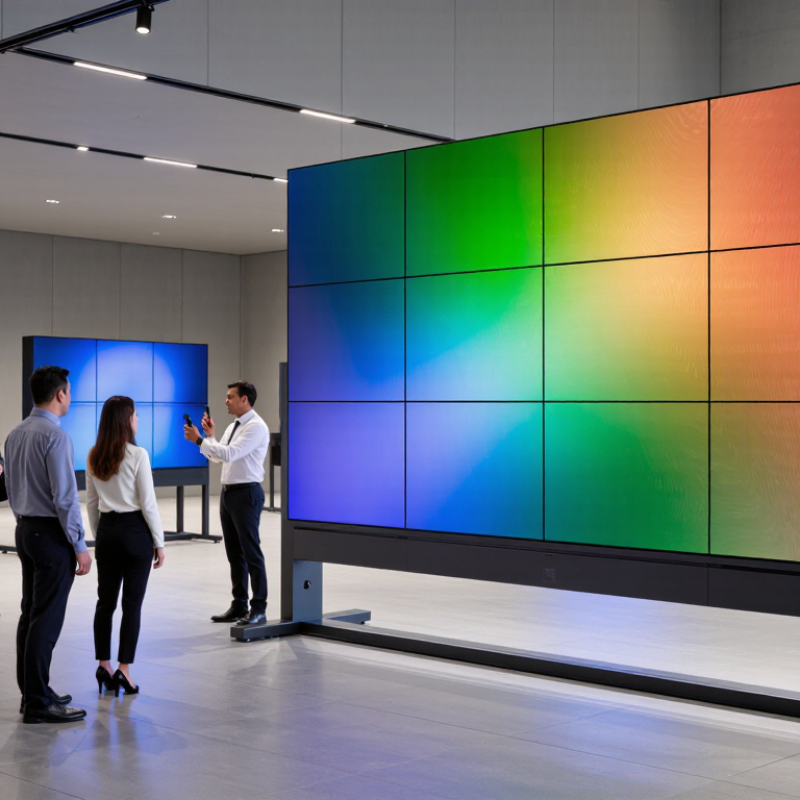
A COB fine-pitch LED display uses chip-on-board packaging. Tiny LED chips are mounted directly onto a circuit substrate, then covered with a protective layer. This creates a compact pixel surface with fewer exposed components than many conventional LED packages. Fine pitch means the distance between neighboring pixel centers is small, so viewers can sit closer before individual pixels become distracting.
The image can look smooth and detailed at short viewing distances. In a control room, for example, small text and thin map lines may remain clear across a large screen. The coated surface also helps protect the LEDs from dust and accidental contact during routine cleaning. Small details matter.
“Fine pitch” has no single cutoff used by every supplier. Buyers should check the actual pixel pitch, viewing distance, brightness, and installation environment. A display suited to a quiet meeting room may not perform as well in a bright public space. Ask for a live demonstration with the content you expect to show.
COB construction can improve surface protection, but it does not make a display immune to damage. Repairs may require specialized tools, and replacement procedures vary by design. That part is easy to overlook. I would compare service access and maintenance requirements alongside image quality, because an impressive screen is less useful when upkeep becomes difficult.
Top COB Fine Pitch LED Display Suppliers in China? - What Is a COB Fine-Pitch LED Display?
| Evaluation Dimension | Fact or Reference | What to Check with a Supplier |
|---|---|---|
| COB Technology | COB means “chip on board”: LED chips are mounted directly onto a circuit substrate and covered with an encapsulating layer. | Ask for the product’s cross-section or technical documentation confirming its packaging structure and surface finish. |
| Fine-Pitch Definition | Pixel pitch is the center-to-center distance between adjacent pixels. “Fine pitch” has no single universal cutoff; product ranges vary by manufacturer and market. | Compare the stated pixel pitch rather than relying on the “fine-pitch” label alone. |
| Example: 0.9 mm Pitch | A square-pixel display at 0.9 mm pitch has approximately 1,111 pixels per metre in each direction (1,000 ÷ 0.9, with pitch expressed in millimetres). | Confirm the actual pixel pitch and native resolution of the proposed cabinet or display configuration. |
| Example: 1.2 mm Pitch | A square-pixel display at 1.2 mm pitch has approximately 833 pixels per metre in each direction. | Check that the resolution suits the intended screen dimensions and viewing conditions. |
| Example: 1.5 mm Pitch | A square-pixel display at 1.5 mm pitch has approximately 667 pixels per metre in each direction. | Request a sample or viewing test using content similar to the planned installation. |
| Surface Protection | The encapsulated COB surface can help protect the LED area from direct contact and dust. Protection level depends on the product’s design and construction. | Request the specified ingress-protection rating and the test conditions behind it; do not infer a rating from COB packaging alone. |
| Brightness | Display luminance is commonly specified in candelas per square metre (cd/m²). Appropriate brightness depends on ambient light and application. | Compare rated brightness, operating settings, and measurement conditions for the complete display. |
| Refresh Rate | Refresh rate is stated in hertz (Hz). The specified value alone does not establish image quality or camera performance. | Ask for the refresh-rate specification and, where cameras will be used, test the screen with the intended camera and shutter settings. |
| Viewing Angle and Uniformity | Viewing angle and brightness or colour uniformity are product-specific performance characteristics, not guaranteed by COB construction alone. | Review the supplier’s measurement method and inspect a powered sample from several viewing positions. |
| Maintenance and Repair | Service procedures vary by display design; some products use front access, while others require rear access or module-level replacement. | Confirm access direction, repair procedure, spare-parts availability, and the process for handling failed pixels or modules. |
| Supplier Verification | Published specifications and certifications apply to the specific model and configuration stated in the supporting documents. | Request model-specific datasheets, test reports, warranty terms, and a written bill of materials for the offered configuration. |
Pixel-density figures are approximate calculations for square pixels based on the stated pitch; actual product configurations and specifications may vary.