
How to Choose a DTH Boring Machine?
Choosing a Dth Boring Machine is not a simple equipment purchase. It is a ground-matching decision. Rock strength, fracture patterns, hole diameter, drilling depth, and site access all affect performance. A machine that works efficiently in compact granite may struggle in broken limestone. Small differences matter.
Mining engineer Dr. Arnold C. Hustrulid is widely respected for his work on drilling and excavation methods. His practical principle is often expressed this way: “The drilling method must match the rock conditions.” That idea should guide every comparison. Buyers should examine impact energy, rotation torque, compressor capacity, feed force, and rod compatibility. They should also check dust control, operator visibility, service access, and spare-parts availability. These details influence uptime more than impressive catalog numbers.
A useful evaluation begins with real site information. Measure the expected hole depth, record the rock type, and estimate daily production. Ask the supplier for performance data from similar ground, not only laboratory figures. A short field trial can reveal excessive vibration, slow penetration, or unstable rod handling. Those problems are expensive.
One point is often missed.
The cheapest Dth Boring Machine may create higher costs through fuel use, bit wear, and unplanned repairs. Yet a larger machine is not automatically better. It may consume more fuel and require wider access roads. Selection involves compromise. Even experienced teams can overlook maintenance conditions during early planning. A reliable choice balances drilling output, safety, mobility, operating cost, and long-term technical support. This guide explains how to compare those factors with greater confidence.
What Is a DTH Boring Machine and How Does It Work?
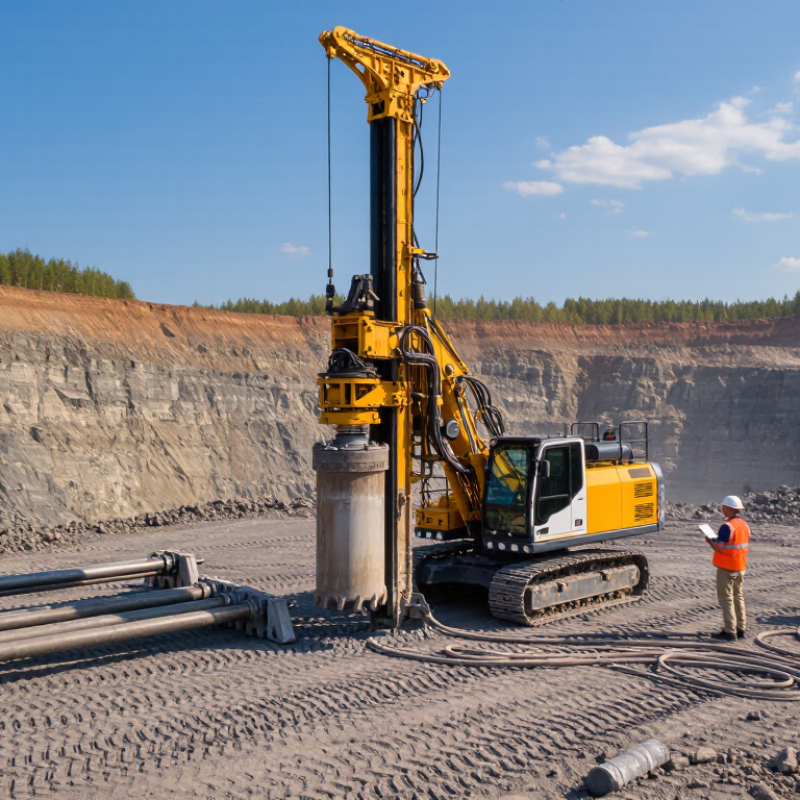
A DTH boring machine, or down-the-hole drilling machine, places its pneumatic hammer inside the borehole. Compressed air drives the piston against the bit, while the drill string rotates and advances. The same air stream lifts rock chips through the annulus. This differs from top-hammer drilling, where impact energy travels through long rods and loses efficiency in deep holes.
Ground conditions decide whether the system performs well. DTH equipment suits hard, abrasive rock, deep blast holes, water wells, and foundation work. In soft clay, fractured ground, or unstable overburden, hole collapse may slow production. Casing or a dual-rotation system may be necessary. Field trials matter more than a brochure rating. A machine rated for 200 meters may deliver less in broken rock, heavy water inflow, or poorly maintained compressors.
Air demand is a practical selection issue. The U.S. Occupational Safety and Health Administration sets respirable crystalline silica limits at 25 μg/m³ as an action level and 50 μg/m³ as an eight-hour permissible exposure limit. Dust collection and wet-control methods should therefore be planned with the machine. The U.S. Geological Survey’s Mineral Commodity Summaries 2025 estimates about 1.5 billion metric tons of crushed stone were produced in the United States in 2024, showing the scale of rock drilling demand. Yet production volume alone can mislead. Bit wear, compressor fuel use, hole deviation, and operator experience often determine the real cost per meter.
Which Ground Conditions Suit Different DTH Machine Types?
How to Choose a DTH Boring Machine?
Ground conditions should guide the machine choice, not the project name. A standard open-hole DTH machine suits competent granite, basalt, and hard limestone. It performs best when the borehole wall remains stable. Hard rock also benefits from high air pressure and strong dust control. The U.S. Geological Survey reported about 1.9 billion metric tons of crushed stone production in 2023. That scale reflects continuing demand for reliable quarry drilling.
Loose overburden needs a different approach. Casing-advancing DTH systems suit gravel, cobbles, weathered rock, and collapsing formations. They keep the casing moving while the hammer breaks harder layers. In saturated clay, however, air drilling can become inefficient. Rotary or mud-assisted methods may perform better. Fractured rock creates another problem. Air loss can reduce hammer energy and slow penetration. The International Society for Rock Mechanics recommends recording fracture frequency and groundwater conditions during site investigation.
Tips: Review borehole logs before selecting equipment. Check rock strength, abrasiveness, water pressure, and casing depth. Match compressor capacity to the hammer’s operating range. Small details matter. Field conditions can change within five metres. My initial machine choice has sometimes looked perfect on paper, then failed after groundwater appeared. Leave room for trial drilling, changing tools, and slower production.
How to Choose a DTH Boring Machine?
Which ground conditions suit different DTH machine types?
Interpretation: Standard DTH systems are most effective in competent medium-hard to hard rock. Casing-advancement DTH systems are better suited to loose overburden and fractured formations because they help stabilize the borehole. Foam- or mist-assisted DTH drilling can improve cuttings removal in broken or water-sensitive ground.
Rock-strength reference: The UCS ranges shown use common engineering classifications: weathered or weak rock at approximately 5–25 MPa, medium-hard rock at 25–75 MPa, hard rock at 75–150 MPa, and very hard rock at 150–250 MPa. Suitability ratings are indicative and should be verified through site investigation and trial drilling.
How to Match Machine Specifications with Project Requirements?
How to Choose a DTH Boring Machine?
Matching a DTH boring machine to a project starts with the rock, not the brochure. Review the geotechnical log for UCS, fracture frequency, weathering, and groundwater. UCS above 100 MPa usually demands higher impact energy, stronger rods, and slower penetration expectations. That number is only a screening point. A fractured 120 MPa granite can drill differently from intact 80 MPa rock. Confirm this with core samples or a short field trial. Hole diameter and depth set the basic machine class. Calculate required pullback, rotation torque, compressor flow, and working clearance together. A powerful compressor cannot rescue an undersized feed system.
Air demand must match the selected hammer and depth. Losses increase through long hoses, narrow lines, wet holes, and elevation. Leave practical reserve, but do not buy capacity blindly. Oversized air systems raise fuel use and may complicate dust control. OSHA’s respirable crystalline silica standard sets a permissible exposure limit of 50 micrograms per cubic meter over eight hours. Therefore, specify wet drilling, sealed cabins, or local extraction where required. Small details matter.
Check production against a measurable cycle: collaring, drilling, rod changes, flushing, and relocation. NIOSH identifies 85 dBA as its recommended exposure limit for an eight-hour workday. Noise data belongs in the selection sheet. Compare quoted penetration with the actual rock profile and consumable life. Ask for test records, calibration certificates, maintenance intervals, and operator training evidence. Industry reports often show ideal rates; real sites are less tidy. I would choose a slightly slower machine with stable flushing and accessible service points. A spreadsheet can still miss mud, slopes, and poor access.
How to Choose a DTH Boring Machine? - How to Match Machine Specifications with Project Requirements?
| Project Requirement | Typical Working Range | Machine Specification to Match | Recommended Selection Criteria | Why It Matters |
|---|---|---|---|---|
| Hole diameter | Approximately 90–311 mm, depending on the application | Drilling diameter range, DTH hammer size, drill pipe diameter, and compressor capacity | Choose a machine whose standard operating range includes the required hole diameter without relying on its maximum limit continuously | Oversized holes require more air, torque, and power. Undersized equipment can reduce penetration and increase component wear. |
| Required drilling depth | About 30–500 m for common construction, water-well, quarry, and geothermal work | Rated drilling depth, feed stroke, mast length, rod length, and rod-handling capacity | Select a rated depth at least 15–25% above the planned depth when ground conditions and casing requirements are uncertain | The usable depth is affected by rod weight, borehole deviation, casing friction, and the number of rod connections. |
| Rock hardness and abrasiveness | Soft to very hard rock; hard rock commonly exceeds approximately 100 MPa unconfined compressive strength | Hammer impact energy, impact frequency, rotation torque, thrust force, and carbide button bit design | For hard or abrasive rock, prioritize higher impact energy, stable feed control, sufficient torque, and wear-resistant drill tools | Hard formations need adequate impact energy and bit loading. Excessive thrust can cause premature bit, shank, and rod damage. |
| Compressed-air supply | Approximately 18–35 bar and 10–50 m³/min, depending on hole size and hammer design | Compressor working pressure, free-air delivery, air hose diameter, and air-treatment system | Match both pressure and air volume; allow for pressure loss in hoses, valves, drill pipe, and altitude-related performance reduction | Insufficient air reduces flushing efficiency, slows penetration, and may allow cuttings to remain in the hole. |
| Borehole flushing and cuttings removal | Dry air flushing, mist injection, foam, or other approved drilling fluids | Air-flow control, dust suppression, water injection, foam pump, cyclone, or wet dust collector | Use dust control and managed flushing where silica-bearing rock, urban work, or environmental restrictions are present | Effective flushing improves drilling speed, protects the hammer, and reduces airborne dust and hole blockage. |
| Rotation torque and speed | Common operating speeds are approximately 20–60 rpm; torque varies with hole size and ground conditions | Hydraulic rotation torque, variable rotation speed, gearbox rating, and overload protection | Choose enough torque for the largest bit, casing, and expected friction rather than matching only the average drilling condition | Low torque can cause stalling, while excessive rotation speed may accelerate bit wear and reduce drilling control. |
| Feed force and pullback capacity | Typically selected according to drill-string weight, casing friction, hole diameter, and formation resistance | Maximum feed force, pullback force, feed speed, chain or cylinder system, and mast strength | Verify that pullback capacity exceeds the combined weight and expected resistance of the rods, hammer, bit, and casing | Adequate feed and pullback force improve penetration, casing recovery, rod handling, and safety during difficult ground conditions. |
| Drilling angle and alignment | Vertical drilling, inclined holes, or controlled angles from approximately 45° to 90° | Mast tilt range, hydraulic leveling, boom articulation, angle indicators, and anchoring system | Select a mast and chassis configuration that covers the required angle while maintaining stable contact with the ground | Accurate alignment reduces hole deviation, casing problems, tool wear, and the risk of unstable operation. |
| Working environment and mobility | Open quarry sites, construction areas, steep terrain, confined spaces, or remote locations | Crawler or truck-mounted chassis, overall dimensions, ground clearance, gradeability, and platform stability | Prioritize compact dimensions for restricted sites and crawler stability or suitable transportability for rough terrain | A machine that cannot safely reach or stabilize at the work location will not deliver its rated drilling performance. |
| Power and fuel efficiency | Power demand increases with hole diameter, depth, air pressure, ground hardness, and auxiliary equipment | Engine power, hydraulic pump capacity, compressor drive, fuel consumption, and emission compliance | Choose sufficient reserve power for simultaneous drilling, tramming, dust control, and auxiliary hydraulic functions | Operating continuously near maximum engine load can increase fuel use, heat generation, downtime, and component wear. |
| Casing and overburden conditions | Loose soil, fractured rock, weathered formations, gravel, or unstable overburden | Casing capacity, casing oscillator compatibility, dual-rotation capability, and auxiliary drilling tools | Specify casing systems when the hole cannot remain open or when groundwater and collapsing formations are expected | A standard DTH setup may not be sufficient in unstable ground without casing or a suitable alternative drilling method. |
| Operator safety and serviceability | Daily operation in dusty, noisy, high-vibration, or remote working conditions | Emergency stops, guarding, dust suppression, noise controls, centralized lubrication, access to service points, and diagnostic displays | Confirm compliance with applicable local safety, emissions, noise, and occupational exposure requirements | Good access and safety systems reduce maintenance time, exposure risks, unplanned downtime, and operating errors. |
Selection note: Final machine sizing should be verified against the drilling contractor’s geological report, borehole design, compressor performance at site elevation, casing plan, and applicable safety regulations.
What Key Features Should You Assess Before Buying?
How to Choose a DTH Boring Machine?
Before buying, match the machine to the ground, hole size, and daily production target. The U.S. Geological Survey reported about 1.9 billion metric tons of crushed stone production in 2023. That scale shows why drilling speed matters, but speed alone can mislead. Assess rated drilling diameter, maximum depth, feed force, rotary torque, and compressor capacity together. A rig with strong torque may still underperform when air volume is insufficient. Check the compressor’s pressure and flow at the drill, not only its brochure rating. Field losses through hoses can be surprisingly serious.
Assess rated drilling diameter, maximum depth, feed force, rotary torque, and compressor capacity together.
Dust control deserves equal attention. The Occupational Safety and Health Administration limits respirable crystalline silica exposure to 50 micrograms per cubic meter over an eight-hour shift. Select wet drilling, enclosed cabs, or effective dust collectors where site conditions require them. Inspect filter access and cleaning time. Small maintenance details become expensive during a long shift. Also examine rod-changing systems, mast stability, ground clearance, noise levels, fuel use, and emergency controls. These features affect operators every hour.
Do not trust one test hole.
Request performance data from ground similar to yours. Ask for penetration rates, bit life, compressor fuel consumption, and downtime records. Independent inspection is wise. Some advertised figures may reflect ideal rock, new tooling, and perfect weather.
I would also calculate service access, spare-part availability, and operator training costs before comparing purchase prices. A cheaper machine can become costly when a blocked air line stops production.
How to Compare Costs, Maintenance, and Operator Safety?
Choosing a DTH boring machine requires more than comparing purchase prices. The lowest quote may hide higher fuel use, compressor demand, or transport costs. Ask for service records, operating data, and a clear warranty scope. I compare cost per drilled metre, not just the machine’s invoice. A fast rig may consume more air and increase daily expenses. Record actual output.
Maintenance costs often decide whether a machine earns money or waits in a workshop. Check how easily technicians can reach filters, hydraulic fittings, drilling tools, and wear parts. Ask for documented service intervals and realistic replacement prices. During field trials, I inspect hose routing and grease points closely. Poor access creates unnecessary downtime. Small delays become expensive.
Operator safety should be included in the purchase calculation. Look for guarded moving parts, stable platforms, clear visibility, reliable emergency stops, and controls that remain readable in dusty conditions. Dust suppression and noise protection matter during long shifts. The cabin should reduce heat, vibration, and blind spots. I also observe whether an operator can complete routine checks without standing near rotating equipment. A clear manual is essential. One weakness remains easy to miss: safety features only work when training matches the machine. My comparisons are not perfect, because ground conditions change daily, but practical demonstrations reveal more than polished brochures.
