How to Choose Thermistors for Your Electronic Projects?
Choosing thermistors for electronic projects can be daunting. Thermistors Have unique properties that affect their performance and suitability. Understanding these properties is crucial for making informed decisions.
A thermistor's resistance changes significantly with temperature. This feature allows for precise temperature measurements. However, selecting the right thermistor involves more than resistance specifications. One must consider the application requirements and environment.
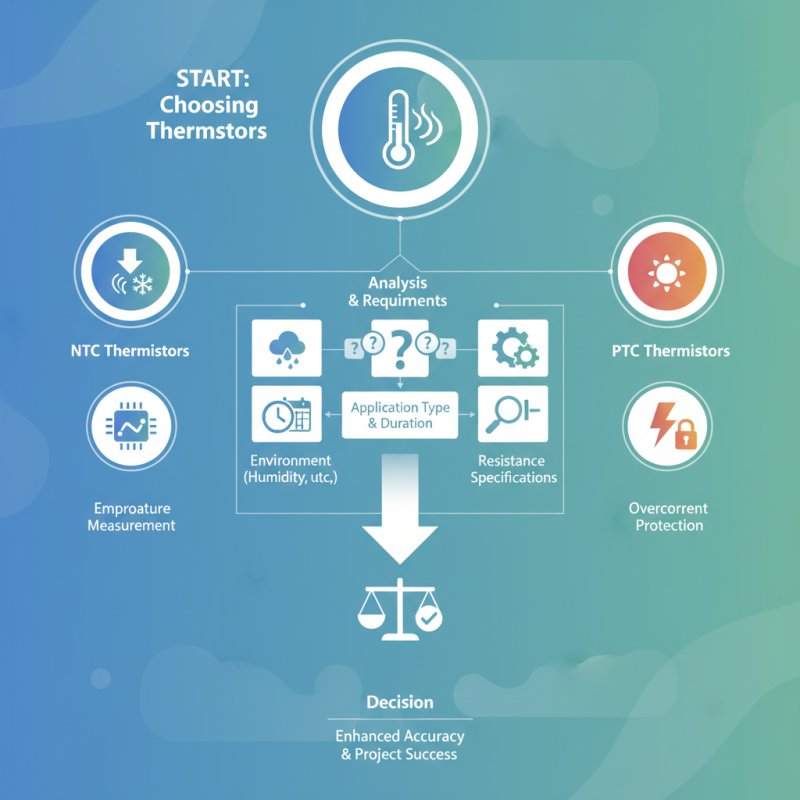
Thermistors have different types, such as NTC and PTC. Each serves distinct functions in circuits. Careful analysis of these characteristics can lead to better project outcomes. A thoughtful choice can enhance accuracy. However, it's important to reflect on the specific needs of your project before deciding.
Understanding Thermistors: Types and Characteristics
Thermistors are vital components in many electronic projects. Understanding their types and characteristics can make a significant difference. There are two main types: Negative Temperature Coefficient (NTC) and Positive Temperature Coefficient (PTC) thermistors. NTC thermistors decrease in resistance as temperature rises, while PTC thermistors do the opposite. Knowing which type to use depends on your application.
Consider the temperature range required. NTC thermistors are great for precise temperature sensing. They offer higher sensitivity in lower ranges. In contrast, PTCs are useful in applications needing current limitation or over-temperature protection. Understanding this can help with project design.
**Tips:** Before purchasing, assess the thermal resistance and tolerance of your thermistors. Look for datasheets for detailed specifications. Sometimes the information can be overwhelming, making it easy to miss critical details. Don't hesitate to experiment. Testing different thermistors in your project may lead to unexpected, yet beneficial insights.
Key Factors in Selecting the Right Thermistor for Your Project
Choosing the right thermistor can significantly impact the performance of your electronic projects. Understanding the key factors in selection is essential. Temperature range is one of the primary considerations. Thermistors are available in various temperature ranges. A typical NTC thermistor may range from -40°C to +125°C. Make sure the thermistor you choose can operate effectively within your project’s specific temperature requirements.
Additionally, the resistance value at a specific temperature plays a crucial role. Most thermistors have a resistance of 1kΩ at 25°C. This is important for compatibility with your circuit. Calibrating for the resistance curve can be tricky. Minor discrepancies may affect your measurements. Aim for precision by investing time in understanding the thermistor’s characteristics.
Tips: Always consult datasheets. These documents provide detailed specifications. They help ensure the thermistor fits your project’s needs. Prototype and test with different thermistors before finalizing your design. Keep an eye on your project’s long-term stability.
Finally, consider the physical size and encapsulation. Thermistors come in various packaging options. Some are epoxy-encapsulated, while others are glass-coated, influencing heat transfer and responsiveness. Remember, the right choice will enhance your project but may require some trial and error. Don’t hesitate to experiment with different options for the best results.
How to Choose Thermistors for Your Electronic Projects? - Key Factors in Selecting the Right Thermistor for Your Project
| Parameter | Description | Typical Values |
| Resistance (25°C) | The nominal resistance at 25°C | 10kΩ, 100kΩ, 1MΩ |
| Beta Value | A parameter that indicates sensitivity to temperature changes | 3000K to 4000K |
| Temperature Range | The operational temperature range of the thermistor | -55°C to 125°C, -40°C to 150°C |
| Tolerance | The accuracy of the thermistor's resistance | ±1%, ±5% |
| Package Type | The physical form of the thermistor | SMD, Leaded, NTC |
| Thermal Time Constant | Time taken to reach a certain percentage of a temperature change | <1s, 3s, 5s |
Determining Temperature Ranges and Sensitivity in Thermistors
When selecting thermistors for electronic projects, understanding temperature ranges is crucial. Thermistors come in two main types: NTC and PTC. NTC thermistors decrease resistance as temperature rises, while PTC thermistors do the opposite. If your project involves precise temperature control, choose an NTC thermistor for better sensitivity at lower temperatures. The temperature range will affect both performance and accuracy.
Sensitivity also plays a significant role in choosing the right thermistor. It describes how much the resistance changes with temperature. A highly sensitive thermistor will provide fine temperature changes, while a less sensitive option may not detect subtle variations. Evaluate your project’s requirements. For example, HVAC systems often need less sensitivity than laboratory instruments. Balancing these factors can be challenging. You might find that a thermistor seems perfect on paper but does not perform well in real-world applications.
Understanding the application context is vital. Conducting tests in actual project conditions helps. Consider all influencing factors, including environment and material interactions. This hands-on approach will help refine your selection process. Ultimately, the right thermistor enhances project effectiveness and reliability. Adjust your choices based on feedback to improve future designs.
Evaluating Electrical Resistance and Response Time of Thermistors
When selecting thermistors for electronic projects, understanding electrical resistance is crucial. Thermistors come in two types: NTC (Negative Temperature Coefficient) and PTC (Positive Temperature Coefficient). NTC thermistors decrease resistance as temperature rises, making them ideal for sensing applications. Conversely, PTC thermistors increase resistance when heated, suitable for overcurrent protection. Knowing the resistance range helps in applications where precise temperature control is necessary.
Response time is another critical factor in thermistor selection. It refers to how quickly a thermistor reacts to temperature changes. A thermistor with a faster response time can provide real-time data, essential in dynamic environments. Generally, smaller thermistors tend to have quicker response times. However, this can lead to trade-offs in sensitivity and overall performance. Ensure to test and evaluate these factors in practice, as theoretical performance and actual results may differ. Balancing resistance and response time is key to optimizing your electronic designs.
Practical Tips for Integrating Thermistors into Your Circuits
Integrating thermistors into your circuits can elevate the performance of your electronic projects. A thermistor is a type of resistor that changes its resistance in response to temperature. Selecting the right thermistor requires careful consideration of the application's needs. Understand the temperature range you are working with. Some thermistors excel in lower ranges, while others perform better in higher ranges.
When designing your circuit, consider the type of thermistor. NTC (Negative Temperature Coefficient) thermistors decrease in resistance as temperature rises. Conversely, PTC (Positive Temperature Coefficient) ones increase resistance with temperature. Keep in mind the nonlinear response of thermistors. This can complicate circuit behavior, causing unexpected results. Adding calibration steps can help. Ensure your microcontroller or ADC can accurately read the thermistor values.
Wiring placements matter as well. Positioning can lead to errors from environmental factors. Testing different placements in your prototype can yield better results. Pay special attention to heat sources nearby. It may seem negligible, but nearby components can influence readings. Always validate your design empirically. What works on paper may not translate perfectly into real-world applications. Adjustments are often necessary during live testing.
Thermistors Temperature Response