How to Choose the Right Sprinkler Truck for Your Needs
Choosing the right Sprinkler Truck starts with the work it must perform, not the largest tank on offer. A municipal crew watering roadside trees has different needs from a contractor controlling dust across a dry construction site. Route length, water access, ground conditions, and daily operating hours all matter. So does the space available for turning and refilling.
Fleet-equipment expert Michael Trent puts the principle simply: “Match the truck to the route, the water demand, and the work cycle—not just the tank size.” A useful reminder. A larger tank may reduce refill stops, but it also adds weight and can limit access on narrow roads. Buyers should compare tank capacity, chassis payload, pump output, spray-bar coverage, hose options, and control placement. Ask to see the equipment working, if possible. A spray pattern on a specification sheet can look convincing; on a dusty road, uneven coverage is easier to spot.
The right choice also depends on service support and maintenance access. Check how filters, valves, and pump components can be inspected, and confirm that local technicians can support the selected setup. Small details count. Can the operator adjust the spray from the cab? Are the controls clear with gloves on? These questions are easy to miss during a sales meeting. They should not be. No single configuration suits every buyer, and this guide will help you weigh the trade-offs before choosing a Sprinkler Truck.
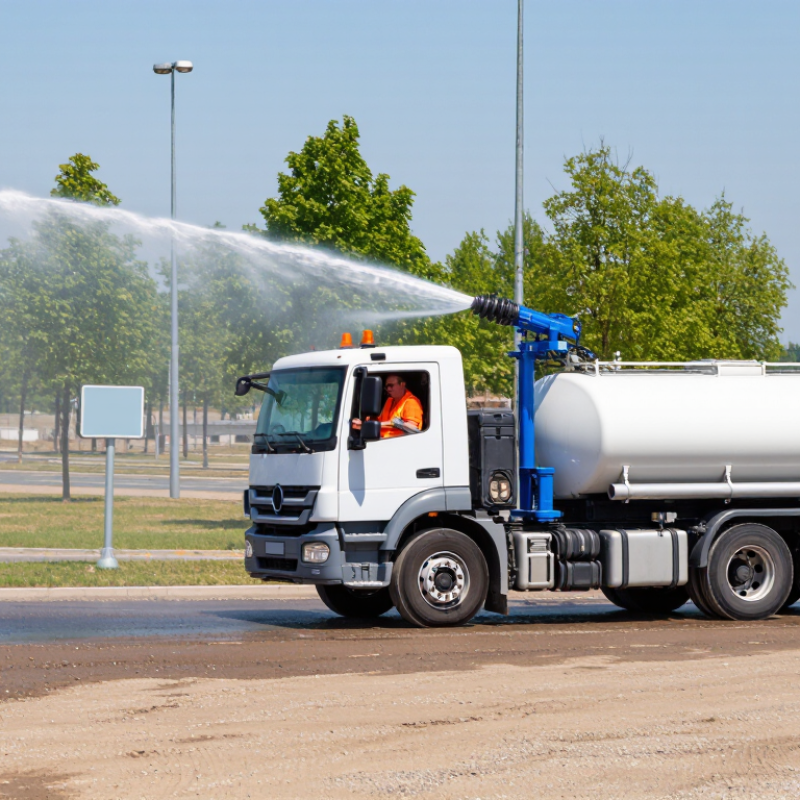
Define the Duty Cycle: Dust Control, Road Washing, or Site Irrigation
Choose the truck by its main duty, not its tank size alone. Dust control usually calls for frequent, even wetting across haul roads; road washing needs stronger, directed flow to move settled grit. Site irrigation needs predictable coverage, suitable nozzles, and careful control of runoff. EPA’s AP-42 chapter on unpaved roads identifies surface moisture, road silt, and vehicle activity as factors affecting dust emissions. That means a spray pattern that works on one site may fail on another. Test it on the actual surface.
For irrigation planning, water supply matters as much as capacity. USGS estimated U.S. irrigation withdrawals at about 118 billion gallons per day in 2015, roughly 42% of freshwater withdrawals. This national figure is not a truck-sizing rule, but it highlights the value of tracking water use. Compare litres per shift, refill distance, pump operating hours, and nozzle output. A large tank can reduce refill trips, yet add weight and make soft ground harder to navigate. That trade-off is easy to underestimate.
Tips: Record one typical shift before buying. Note the task, spray duration, refill delays, and ground conditions. Then check pump ratings and nozzle coverage against that record. A tidy calculation can still miss changing weather; review the plan after a dry week.
Sources: US EPA AP-42, Section 13.2.2; USGS, Estimated Use of Water in the United States in 2015.
Select Tank Size: Commercial Water Trucks Commonly Hold 2,000–5,000 gal
Commercial sprinkler trucks commonly carry 2,000–5,000 gallons, but the right capacity depends on refill access and daily water demand. A 2,000-gallon tank suits shorter routes or frequent refill stops; a 5,000-gallon tank can reduce interruptions on larger sites. More water also means greater payload, so check the truck’s rated capacity, not just the tank volume. That matters on site.
For a practical reference, USDA NRCS’s National Engineering Handbook, Part 652, gives the standard conversion of 27,154 gallons per acre-inch of water. A 2,000-gallon load equals about 0.074 acre-inch; 5,000 gallons equals about 0.184 acre-inch. This is a planning benchmark, not a promise of road coverage. Nozzle output, driving speed, overlap, and evaporation all affect how far a load goes. Track gallons used per route and refill time for several shifts. The estimate may be imperfect at first. Revise it using actual site conditions, including dusty stretches, uneven ground, and the distance between water sources.
How to Choose the Right Sprinkler Truck for Your Needs — Select Tank Size: Commercial Water Trucks Commonly Hold 2,000–5,000 gal
The water weights below are approximate and use 8.34 lb per US gallon. They represent water only—not the tank, truck, equipment, or passengers. Confirm the loaded vehicle weight and axle loads against the truck’s ratings and applicable regulations.
| Tank Capacity | Approx. Water Weight | Potential Fit | Refill Planning | Key Selection Check |
| 2,000 gal | 16,680 lb | Smaller work areas, shorter routes, or sites where maneuverability and frequent access to water are priorities. | Plan for more frequent refills than with larger tanks when daily water demand is similar. | Check that the fully loaded truck—including water and equipment—stays within its GVWR and axle-weight limits. |
| 3,000 gal | 25,020 lb | A middle-capacity option for varied site work where a balance between water carried and vehicle size is needed. | Compare the route length and expected spray or dust-control demand with the available refill locations. | Verify chassis capacity, tank mounting, and weight distribution with the vehicle specifications. |
| 4,000 gal | 33,360 lb | Larger work areas or longer operating intervals between water sources, where the truck can safely accommodate the load. | A larger tank can reduce refill trips, but only if the truck can carry the water legally and the site can be accessed safely. | Review loaded axle weights, road restrictions, turning space, and access conditions before choosing this capacity. |
| 5,000 gal | 41,700 lb | High-demand operations with suitable access, refill logistics, and a truck specifically rated for the intended load. | Assess water availability and refill time; maximum capacity is useful only when supply and operating conditions support it. | Do not select by tank volume alone: confirm the complete loaded weight, axle ratings, tank compatibility, and local requirements. |
Convert Capacity to Payload: Water Adds 8.34 lb per U.S. Gallon
When comparing sprinkler trucks, convert gallons into pounds before judging tank size. Water weighs about 8.34 pounds per U.S. gallon. A 500-gallon load adds roughly 4,170 pounds; 1,000 gallons adds 8,340 pounds. Multiply usable gallons by 8.34 for a quick estimate. That is substantial. A partially filled tank weighs less, but rated capacity is a safer starting point.
That figure is water alone. The tank, pump, hose reels, piping, and crew also consume capacity. Compare the loaded truck’s weight with its gross vehicle weight rating, and check front and rear axle ratings separately. A truck can stay below its total rating while one axle is overloaded.
Use the expected working fill, not just advertised tank volume. For example, 750 gallons weighs about 6,255 pounds before equipment is counted. Leave room for tools and water in auxiliary systems. Then confirm the numbers against scale weights and vehicle documentation. I still find this easy to misjudge on paper. Real loads shift.
Check Chassis Limits: FMCSA’s General Interstate GVWR Cap Is 80,000 lb
How to Choose the Right Sprinkler Truck for Your Needs
Before choosing a sprinkler truck, check both its chassis rating and its expected loaded weight. On most U.S. Interstate highways, federal rules generally limit gross vehicle weight to 80,000 lb, while axle and bridge-formula limits may require a lower weight. GVWR is the vehicle’s rated maximum; it is not permission to load up to that number on every route. Water adds up quickly: one gallon weighs about 8.34 lb, before counting the tank, pump, chassis, crew, and tools. A full tank can push an otherwise suitable truck over its limits.
Tips: Ask the dealer or upfitter for a weight breakdown by axle, then compare it with the truck’s ratings and your planned routes. Leave room for hoses, fittings, and other equipment you may add later. Weigh the completed truck, ideally with a full tank and normal gear. Small details matter.
A truck that works on a job site may not suit interstate travel. Check local and state rules, since limits and requirements can vary by route. I have seen buyers focus on tank capacity and overlook front-axle loading; that is an easy mistake to make. If the weight figures are unclear, get them verified before ordering.
Compare Pump, Nozzle, and Spray-Bar Flow Against Required Coverage
A sprinkler truck should match the water rate your work actually needs, not just the pump’s advertised maximum. Check pump flow at the pressure required by your nozzles; higher pressure can reduce available flow. Add the flow ratings of all nozzles operating at once, then confirm the pump can supply that total with a working margin. A mismatch can produce weak, uneven streams. That matters.
Compare the spray bar’s effective width with the area you need to cover at your planned driving speed. Wider spacing or a faster pass may leave dry stripes, even when total flow looks adequate. Test the pattern on pavement with catch containers placed across the bar. Look for consistent amounts, including near the outer nozzles. A small gap can become obvious over a long route. Real sites are messier: wind, slope, and vehicle movement all change the pattern. Recheck after adjusting pressure or nozzle size. I would not trust one clean test as a perfect answer; field conditions rarely stay that tidy. If coverage is uneven, slow the truck, adjust the bar, or select nozzles with suitable flow and droplet size.