
China Best Pull Out Ironing Board Drawer Supplier?
Choosing the best China supplier for a Pull Out Ironing Board Drawer requires more than comparing prices. A reliable supplier should understand furniture hardware, compact living, and daily household use. The drawer must open smoothly, remain stable, and support the ironing board without excessive movement. Look for experience with steel frames, heat-resistant covers, soft-closing runners, and space-saving cabinet designs. These details affect safety, comfort, and product life.
Ask suppliers for material specifications, load test results, production photos, and clear quality-control procedures. A professional factory should explain how it checks welding points, drawer alignment, surface coatings, and packaging protection. Samples are essential. Test the drawer in a real cabinet, place an iron on the board, and observe its movement after repeated opening and closing. Small problems become expensive later. Very expensive.
Trust also depends on communication. The supplier should answer technical questions directly and provide consistent dimensions, lead times, and inspection records. Certifications may support credibility, but they should match the actual product and destination market. Do not rely on attractive catalog images alone. Some suppliers present strong designs but offer limited customization or weak after-sales support. That possibility deserves attention.
This guide examines how to compare Chinese manufacturers, verify product quality, and assess long-term cooperation. It also considers cabinet compatibility, shipping protection, customization, and practical installation needs. The “best” supplier may not be the cheapest. It should be the one that delivers stable performance, honest documentation, and dependable service. Even experienced buyers can overlook drawer clearance or packaging damage. Careful evaluation reduces that risk.
What Defines a Reliable Pull-Out Ironing Board Drawer Supplier?
A reliable pull-out ironing board drawer supplier offers more than attractive product photos. They understand cabinet measurements, rail clearance, heat exposure, and daily folding pressure. Their technical team should provide accurate drawings, material details, load testing, and installation guidance. Ask for a working sample before placing a large order. Small details matter, such as smooth runners, stable hinges, quiet movement, and a board that closes without scraping. A dependable supplier also explains limitations honestly.
Tips: Check sample quality carefully. Measure every connection point. Ask about replacement parts, packaging, and warranty terms. Request inspection records when available. Clear answers usually reveal strong production control.
Supplier reliability also depends on communication. Responses should be specific, not copied from a catalogue. Production updates, inspection photos, and realistic delivery schedules reduce avoidable problems. Experienced suppliers can suggest practical changes when your cabinet design has tight space or unusual dimensions. However, no supplier is flawless. Even a well-designed drawer may need adjustment after installation. This is where service becomes important. A supplier should accept reasonable feedback and document corrective actions. Be cautious when promises sound perfect. Honest technical advice is often more valuable than the lowest quotation.
What Defines a Reliable Pull-Out Ironing Board Drawer Supplier?
This procurement benchmark shows how buyers can prioritize supplier reliability: consistent product quality, engineering capability, quality control, delivery performance, regulatory compliance, and after-sales support. The percentages are evaluation weights rather than company performance results.
How Pull-Out Ironing Board Drawer Systems Work
China Best Pull Out Ironing Board Drawer Supplier?
How Pull-Out Ironing Board Drawer Systems Work
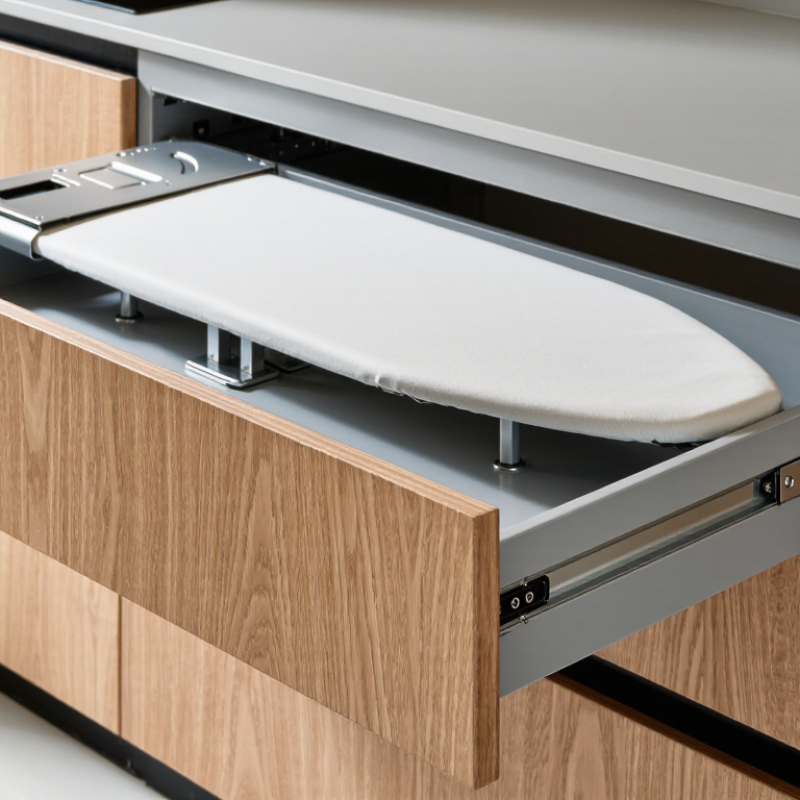
A pull-out ironing board drawer system hides inside a cabinet or wardrobe. The drawer connects to heavy-duty runners fixed on both sides. When opened, the runners guide the board forward with controlled movement. A folding frame then lowers the ironing surface into a working position. Many systems use a locking joint to prevent sudden collapse. The board usually includes a heat-resistant cover and ventilation gaps beneath the fabric.
In practical cabinet testing, smooth alignment matters more than appearance. The drawer should open without scraping, wobbling, or excessive side movement. A soft-close mechanism can reduce impact, but it cannot correct poor installation. Measure the cabinet width, depth, and internal clearance before selecting hardware. Check the runner load rating, screw quality, frame thickness, and replacement parts. These details reveal whether a supplier understands long-term use.
A common mistake is trusting a high load rating alone. An ironing board carries downward pressure during pressing, not only its own weight. Weak joints may loosen after repeated folding. I would also request sample testing before bulk production. Test the board with a full water container nearby, then inspect the hinges and drawer movement. Some designs feel excellent on the first day but become stiff later. That possibility deserves honest discussion with the supplier.
Key Materials, Designs, and Customization Options
Choosing the best pull out ironing board drawer supplier in China starts with materials, not catalog photos. In production, cold rolled steel is often used for the sliding frame because it resists bending under repeated loads. Powder coating helps protect the frame from moisture and scratches. For the board surface, heat resistant fiberboard, plywood, or compact laminated panels offer different balances of strength, weight, and cost.
Drawer design affects daily comfort. Full extension runners allow the board to move forward smoothly, even inside a deep cabinet. Soft closing hardware reduces noise, but it can add weight and require accurate installation. A swivel mechanism may improve access in narrow rooms. Ventilation holes should be placed carefully, since weak spacing can reduce board stiffness. Small details matter.
Customization can include board width, folded depth, mounting position, handle shape, fabric color, and runner length. Suppliers should provide drawings, load tests, and sample measurements before mass production. In my experience, a prototype often exposes problems that digital drawings miss. A drawer may scrape. The ironing surface may sit too low. These issues are fixable, but ignoring them is costly. I would also check coating thickness, screw quality, edge finishing, and repeated opening tests. No supplier is perfect. Clear inspection records and honest communication usually matter more than impressive promises.
How to Evaluate Manufacturing Quality and Supplier Capabilities
China Best Pull Out Ironing Board Drawer Supplier?
How to Evaluate Manufacturing Quality and Supplier Capabilities
A reliable supplier should prove quality beyond attractive product photos. The 2023 ISO Survey recorded more than 1.26 million ISO 9001 certificates worldwide. Certification helps, but it does not replace factory evidence. Request process maps, inspection records, and recent corrective-action reports. Check whether the supplier controls steel thickness, board flatness, slide alignment, and heat-resistant fabric batches. A useful sample should open smoothly without sideways movement. Measure the drawer gap with a caliper. Small errors become obvious after installation.
Ask for load testing, repeated opening tests, and corrosion checks. The supplier should provide test conditions, equipment details, and signed results. Do not accept a simple “passed” statement. For domestic furniture, applicable safety requirements and material declarations should also be reviewed. The European Commission’s 2023 Safety Gate report listed more than 3,400 product alerts, showing why traceability matters across consumer goods. Manufacturing experience is visible in details: protected corners, consistent screw torque, replaceable covers, and packaging that prevents rail damage. Visit the factory if possible. Watch one complete assembly, not only a prepared showroom sample.
A polished sample can still mislead. In one practical inspection, a drawer worked well unloaded but sagged after repeated use. That weakness was easy to miss. Supplier capability should include stable production capacity, trained inspectors, spare-part planning, and honest responses to defects. Perfect claims deserve more questions.
China Best Pull Out Ironing Board Drawer Supplier? - How to Evaluate Manufacturing Quality and Supplier Capabilities
| Evaluation Dimension | What to Evaluate | Recommended Acceptance Benchmark | Verification Method | Suggested Weight |
|---|---|---|---|---|
| Product Structure | Drawer-mounted ironing board design, hinge layout, locking mechanism, clearance, and installation compatibility. | Board opens and closes smoothly without binding; the locking mechanism holds the board securely in both stored and working positions. | Review engineering drawings, inspect a production sample, and test the product in the intended cabinet or drawer structure. | 15% |
| Load Capacity | Static load resistance of the board, rails, hinges, mounting brackets, and fixing points. | The supplier should define a rated load and demonstrate a safety margin through documented testing. A minimum 20% safety margin above the stated working load is a practical purchasing benchmark. | Request test records and conduct a witnessed load test using calibrated weights. | 12% |
| Dimensional Accuracy | Flatness, board thickness, mounting-hole position, drawer width, and overall retracted dimensions. | Critical dimensions should be controlled according to approved drawings. For metal or machined mounting parts, a general tolerance around ±0.5 mm is a useful starting point unless the drawing specifies otherwise. | Use calipers, gauges, and a dimensional inspection report based on the approved technical drawing. | 12% |
| Material Specification | Steel or aluminum grade, rail material, fastener quality, board core, cover fabric, and heat-resistant components. | All materials should be listed in the bill of materials and traceable to supplier declarations or purchase records. Materials must be suitable for repeated household heat and mechanical use. | Check the bill of materials, material certificates, incoming inspection records, and random sample composition where required. | 10% |
| Surface Treatment | Powder coating, plating, paint adhesion, corrosion resistance, edge finishing, and visible-surface consistency. | No sharp edges, exposed rust, peeling, blistering, or visible coating defects. The required corrosion test duration should be agreed according to the destination market and product specification. | Perform visual inspection, coating-thickness checks where applicable, adhesion testing, and independent corrosion testing for higher-risk applications. | 10% |
| Cycle Durability | Repeated opening, unfolding, folding, closing, and locking of the complete assembly. | A supplier should provide a documented cycle target suitable for the intended use. A buyer-defined test of at least 5,000 operating cycles is a reasonable baseline for screening household products. | Review durability test records and conduct sample testing for noise, looseness, deformation, and locking performance after cycling. | 15% |
| Safety and User Protection | Finger-pinch risks, sharp corners, unexpected board movement, heat exposure, fabric flammability, and fastener security. | No accessible sharp edges or unstable movement during normal use. Safety warnings, installation instructions, and heat-related precautions should be supplied where applicable. | Complete a product safety checklist, review risk-analysis documents, and test the assembled product under normal and foreseeable misuse conditions. | 10% |
| Quality Management | Incoming inspection, in-process controls, final inspection, nonconformance handling, and corrective-action procedures. | The factory should maintain documented inspection plans, inspection equipment, batch records, and corrective-action reports. An ISO 9001-certified system is useful but should not replace product-level verification. | Conduct a factory audit and review inspection records from recent production batches. | 10% |
| Production Capability | In-house or controlled processes for stamping, bending, welding, coating, assembly, packaging, and tooling maintenance. | The supplier should identify process ownership, available equipment, production capacity, lead-time assumptions, and contingency plans for critical components. | Review the process flow, equipment list, capacity plan, workforce, subcontractor controls, and sample production records. | 8% |
| Compliance and Documentation | Technical file, user instructions, packaging specifications, restricted-substance requirements, and destination-market compliance. | Documents should match the final product configuration, revision level, and destination-market requirements. Regulatory claims must be supported by valid test reports. | Check certificates, declarations, test reports, artwork, manuals, and revision-controlled technical documents. | 5% |
| Packaging and Logistics | Protection against scratches, deformation, moisture, missing hardware, and transit movement. | Packaging should protect moving parts and finished surfaces, include installation hardware, and pass an agreed transport simulation or drop-test standard when required. | Inspect packaging samples, conduct distribution testing, and verify carton labels, packing lists, and shipment traceability. | 3% |
| Total Suggested Evaluation Weight | 100% | |||
What to Check Before Choosing a Supplier?
What to Check Before Choosing a Pull-Out Ironing Board Drawer Supplier?
A reliable supplier should prove more than a polished catalogue. Ask for factory photos, material specifications, and recent inspection records. Check whether the drawer uses corrosion-resistant steel, stable runners, and heat-resistant board coverings. The board should open smoothly and stay level under pressure. Request cycle-test results for the sliding mechanism. ISO 7170 storage-unit testing can provide a useful reference, where applicable. Still, a certificate alone does not prove consistent production.
The global home furniture market reached about USD 516.66 billion in 2022, according to Grand View Research, with projected growth from 2023 to 2030. This expanding market attracts capable manufacturers and weaker imitators. Compare sample quality, minimum order quantities, lead times, and replacement policies. Ask how the supplier controls dimensional tolerance. A drawer that misses the cabinet opening by only a few millimeters can create installation problems. Houzz research also shows strong homeowner interest in upgraded kitchen storage, making practical space-saving hardware increasingly relevant. The report is not specific to ironing drawers, but the connection is reasonable, not perfect.
Tips: Order a production sample before signing a large contract. Measure the closed depth, extension length, board width, and fixing-hole positions. Test it with a warm iron, a heavy cotton garment, and repeated opening cycles. Ask for a written defect standard, packaging photos, and batch traceability. One overlooked detail is noise. Request a closing test in a quiet room. Also, admit uncertainty: supplier claims may sound precise, but independent inspection remains safer.
