
What Are the Best Types of Outdoor Wall Lights?
Outdoor Wall Lights do more than brighten a doorway. They shape how a home looks after sunset, help visitors find steps, and make entrances feel more welcoming. The best choice depends on the wall, the task, and the atmosphere you want. A compact lantern can suit a narrow porch, while a shielded downlight may better illuminate a side path without shining into a neighbor’s window. Small details matter.
The U.S. Department of Energy reports that LED lighting uses at least 75% less energy and can last up to 25 times longer than incandescent lighting. That makes LED-compatible fixtures a practical starting point, though a fixture’s design and placement still affect comfort and visibility. DarkSky International’s guidance also emphasizes using light only where and when needed, directing it downward, and choosing warm-colored light. In practice, a motion-sensor sconce can serve a rarely used side entrance; a dusk-to-dawn lantern offers steadier light near a busy front door.
There is no single “best” type. Not even close. This guide compares classic lanterns, modern sconces, up-and-down lights, motion-activated fixtures, and other common options. It considers brightness, beam direction, weather exposure, controls, and visual style. One honest caveat: a brighter fixture is not automatically a safer or better one. A poorly aimed light can create glare, while an attractive fixture may leave a step in shadow. The right choice balances useful illumination with restraint—and fits the actual conditions around your home.
How Outdoor Wall Lights Are Defined and Classified
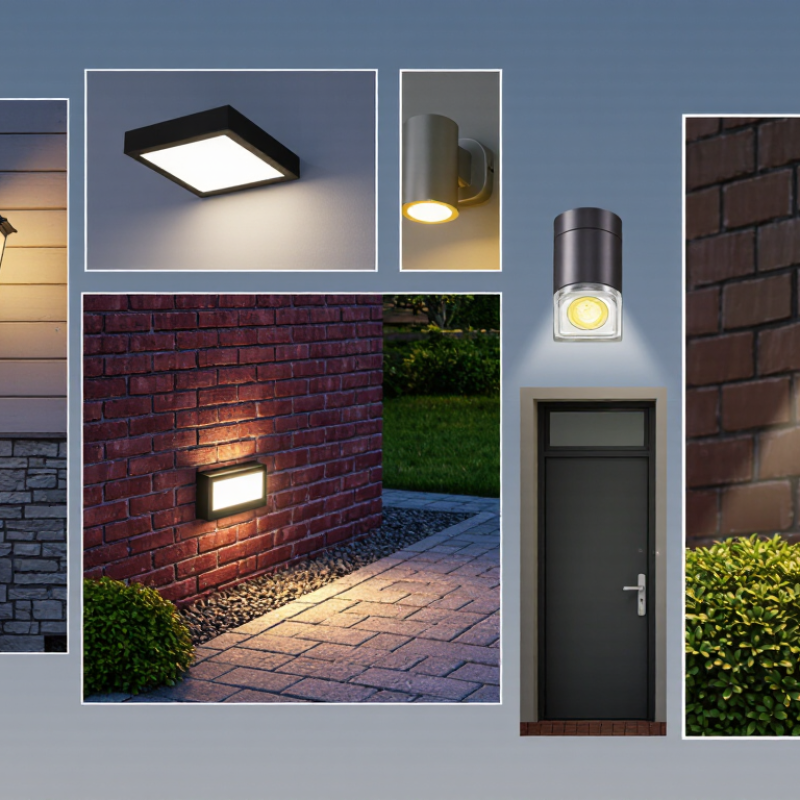
Outdoor wall lights are fixed luminaires mounted on exterior walls to provide visibility, accent, or security lighting. They are commonly classified by how they direct light. Downlights cast beams toward paths or doorways, while uplights highlight walls and architectural details. Up-and-down fixtures send light in both directions. Lantern-style and bulkhead designs describe a fixture’s shape, so they can also be downlights or ambient lights.
Another useful classification is by function and control. Motion-sensor lights switch on when movement is detected; dusk-to-dawn models respond to changing light levels. Some fixtures use replaceable lamps, while others have integrated LED modules. These categories can overlap, which makes product labels a little confusing. A decorative fixture may still provide practical entry lighting, but its beam may not reach far across a wide porch. Check the light distribution, mounting height, and weather-resistance rating for the intended location.
Tips: Stand where the light will be used and note what needs illumination, such as a house number or steps. Choose a shielded fixture near eye level to reduce glare. Check the installation instructions and wall material before mounting; even a suitable light can perform poorly when placed too high.
The Main Types of Outdoor Wall Lights
Outdoor wall lights come in several forms, and each suits a different wall, entry, or routine. Lantern-style fixtures have clear or frosted panels that soften the bulb’s appearance. They work well beside a front door, where their familiar shape adds a welcoming touch. Still, glass can show dust and water marks, so it may need regular cleaning.
A traditional wall sconce sits close to the wall and directs light outward or downward. Choose a shielded design to reduce glare when people approach the entrance. Flush-mounted fixtures are more compact, making them practical under low eaves or along narrow side passages. Simple, but useful. Up-and-down lights cast beams above and below the fixture, creating a crisp look on textured brick or stucco. Their effect depends on the wall surface; a plain, smooth wall may look less dramatic.
Gooseneck or barn-style lights project farther from the wall and spread light over a porch, garage door, or outdoor work area. Motion-sensor security lights are another type, switching on when movement is detected. They can help illuminate a dark path, though a poorly aimed sensor may react to passing cars or swaying branches. Before choosing, note the mounting height, nearby corners, and where shadows fall after dusk. I have found that a bright fixture is not always the most comfortable one.
How Light Direction Shapes Each Fixture’s Use
Outdoor wall lights work best when their beams match the task. A downward-facing sconce sends light onto steps, house numbers, and narrow paths, where feet need clear edges. Choose a shielded downlight beside a door to limit glare into approaching eyes. Aim low. DarkSky International’s Five Principles for Responsible Outdoor Lighting recommend useful, targeted, controlled light rather than illumination beyond the task.
Up-and-down fixtures cast paired beams across masonry, revealing brick texture and adding depth to a blank wall. They suit patios and feature walls, but upward spill can brighten windows or the night sky. A broad, diffused sconce softens shadows near seating, though it offers less precise path visibility. Check the beam at standing height, not only in a product image. I still find that detail easy to miss.
Energy matters too. The U.S. Department of Energy’s 2017 Energy Savings Forecast for Solid-State Lighting projected annual savings of about 569 terawatt-hours by 2035. That national estimate cannot predict one home’s savings, but it supports choosing efficient LEDs and avoiding needless output. Pair the right beam with a timer or motion control, then test it after dark. Less glare.
| Fixture Type | Light Direction | Best Uses | Key Advantages | Placement Considerations |
|---|---|---|---|---|
| Downlight wall sconce | Downward | Entryways, porches, and paths beside a wall | Directs light onto the ground and can help limit glare toward the sky. | Mount near doors or along walking routes; aim the beam away from neighbors’ windows. |
| Uplight wall sconce | Upward | Highlighting architectural details, columns, or textured walls | Creates a decorative wash that draws attention to surfaces above the fixture. | Use where the light can fall on a suitable surface; avoid unnecessary upward spill into the night sky. |
| Up-and-down wall light | Both upward and downward | Patios, exterior feature walls, and modern entrances | Provides a balanced decorative effect on the wall above and below the fixture. | Allow clear wall space in both directions, and check that the upward beam will not cause unwanted glare. |
| Full-cutoff wall pack | Primarily downward, with little or no light above the horizontal | Side doors, service areas, and building perimeters | Can illuminate the area near a building while helping reduce glare and light spill above the fixture. | Choose a suitable mounting height and beam spread so the illuminated area is not excessively bright or uneven. |
| Barn-style shade light | Downward and outward beneath a shade | Outdoor work areas, garages, and utility entrances | The shade helps direct light onto a nearby task area and can shield the lamp from some viewing angles. | Position it over the area needing light; confirm the shade does not block useful illumination at the edges. |
| Recessed wall step light | Downward or outward at a low angle | Stairways, retaining walls, and changes in level | Offers low-level guidance while keeping the fixture profile discreet. | Space fixtures to make steps and edges easy to see; use products rated for the location and exposure. |
| Floodlight with adjustable head | Adjustable, commonly aimed outward and downward | Driveways, side yards, and broad security coverage | Can cover a larger area, and an adjustable head allows the beam to be aimed toward a specific zone. | Aim only at the intended area; avoid directing the beam into windows, neighboring properties, or drivers’ line of sight. |
| Decorative lantern | Diffuse light in several directions | Porches, front doors, and traditional-style exterior spaces | Provides a visible decorative feature and soft ambient light around an entrance. | Use an appropriate brightness for the space; a clear-glass lantern may need a carefully chosen lamp to control glare. |
Comparing Outdoor Wall Lights by Location and Purpose
What Are the Best Types of Outdoor Wall Lights?
Comparing Outdoor Wall Lights by Location and Purpose
At a front entrance, choose a downward-facing wall lantern that lights the lock, steps, and faces without shining into nearby windows. For a long walkway, evenly spaced, shielded fixtures can reduce dark gaps better than one bright light. Near a garage, a wider beam helps illuminate the door and driveway; a motion sensor can keep it off when nobody is there. On a covered patio, softer, warm-toned light usually feels more comfortable than a stark, high-output beam. Details matter.
Match brightness to the task, not the largest fixture available. The U.S. Department of Energy reports that LEDs use at least 75% less energy and can last up to 25 times longer than incandescent bulbs. That comparison supports LED efficiency, but it does not mean every LED fixture is suitable outdoors. Check its wet- or damp-location rating for the mounting site. DarkSky International’s responsible-lighting guidance also recommends directing light downward, using only the amount needed, and choosing warmer color temperatures. A perfect setup is not always practical; neighboring windows and reflective siding can still create glare.
How to Choose the Right Outdoor Wall Light for Your Home
Choosing an outdoor wall light starts with its job, not its shape. At a front door, look for even illumination on the lock, steps, and visitors’ faces. A narrow beam can leave dark patches; a broad, shielded fixture often feels calmer. For a garage or side path, prioritize coverage and durable construction over decorative detail. Check the fixture’s outdoor rating and suitability for rain, dust, and temperature swings. Small details matter.
Measure the wall space and note nearby windows, eaves, and door swings before choosing a size. A fixture that looks modest online may dominate a narrow entry. Compare light output, not wattage alone, and choose a warm or neutral color that suits your exterior. Warm light often feels welcoming; neutral light can make address numbers and steps easier to distinguish. Avoid glare into bedrooms or toward neighbors with a shielded design that directs light downward. Dimmers or motion sensors can help, but only if they suit the fixture and your routine.
Material choice matters too: coated metal and sealed components generally handle exposure better than delicate finishes. Still, no fixture is maintenance-free. Salt air, sprinkler spray, and leaves can shorten its service life, so inspect seals and clean the lens occasionally. If wiring is new or uncertain, ask a qualified electrician to assess the connection and follow local requirements. I wouldn’t choose by appearance alone; that’s an easy mistake. The best light is one you barely notice until you need it.
What Are the Best Types of Outdoor Wall Lights?
Compare common IP ratings when choosing a lantern, bulkhead, up-and-down light, or motion-sensor fixture. The second digit indicates protection against water; the fixture type itself does not determine its IP rating.
How to read it: IP44 and IP54 are rated for splashing water, IP65 for water jets, and IP66 for powerful water jets. Check the product’s full rating and installation guidance to make sure it suits your location.
