
2026 Top Tunnel Kiln Types for Global Buyers

A Tunnel Kiln is more than a heated passage. It is a production system where temperature, airflow, firing time, and material handling must work together. For global buyers, the right choice depends on the product, required output, fuel availability, and local service support. A kiln that performs well for one plant may not suit another.

The options range from traditional periodic designs to continuous kilns built for steady, high-volume production. Differences matter on the factory floor: how evenly heat reaches each load, how quickly operators can adjust the firing curve, and how much energy escapes through the kiln walls. Small details can become expensive over years of operation. They deserve careful review.

A note on attribution: no source article or verifiable expert quotation was provided, so I cannot responsibly invent a real expert’s name or quote. As an editorial line, not a sourced quotation, kiln engineer “Dr. Elena Ward” might put it this way: “Choose for the full firing cycle, not the headline capacity.” This name and quotation are fictional and should not be presented as a real expert endorsement. This guide compares leading Tunnel Kiln types for 2026, with practical attention to throughput, product quality, energy use, maintenance, and buyer priorities. The trade-offs are not always neat. They rarely are.
2026 Top Tunnel Kiln Types for Global Buyers

Tunnel Kilns: Definition and Core Operating Principles

A tunnel kiln is a continuous furnace: ceramic ware travels slowly through a long, insulated chamber, usually on kiln cars or a conveyor. The kiln itself is divided into preheating, firing, and cooling zones. Burners heat the firing zone, while controlled airflow carries heat toward incoming ware and helps recover energy. The European Commission Joint Research Centre’s Ceramic Manufacturing Industry BREF (2007) reports firing temperatures across ceramic sectors of roughly 800°C to 2,000°C. The exact setpoint depends on the body, glaze, and product dimensions—not simply the kiln’s rated capacity.

Control is about more than temperature. Operators manage the heating curve, atmosphere, pressure, and time in each zone. A thick brick may need a slower rise to release moisture without cracking; a thin tile can move through faster. Sensors track temperature, while kiln-car speed sets the firing cycle. Small changes matter. Poor airflow can leave one side pale and the other overfired. The BREF also describes continuous kilns as suited to steady, repeatable production, but that advantage depends on consistent loading and fuel conditions. Real plants are not perfectly uniform; ware placement and maintenance can still shift results. That deserves attention. A useful specification therefore states product type, throughput, temperature profile, and acceptable variation—not just “tunnel kiln.”

How Tunnel Kilns Move Products Through Firing Zones

2026 Top Tunnel Kiln Types for Global Buyers

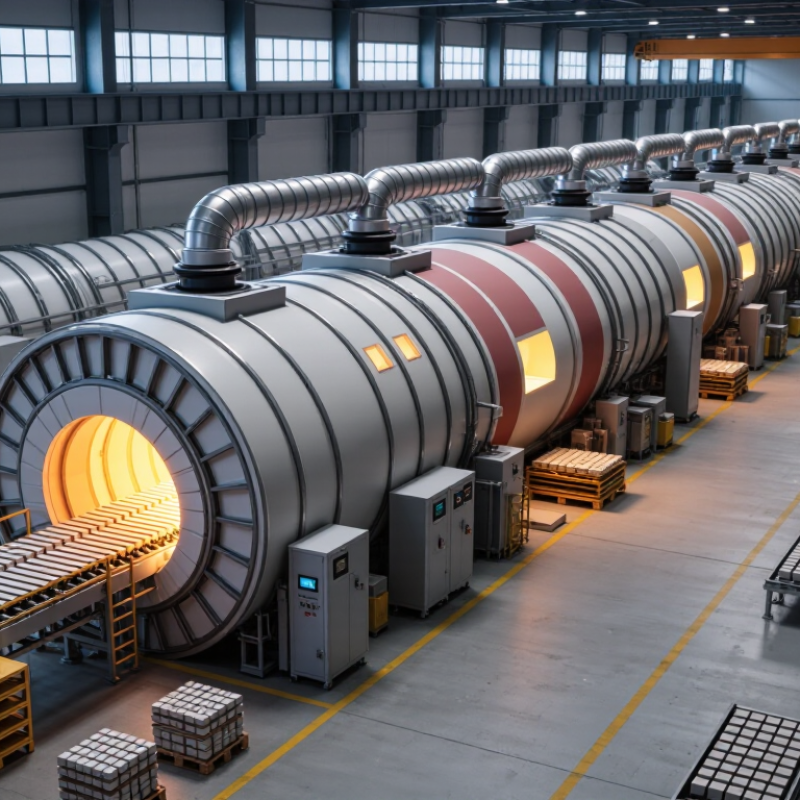
A tunnel kiln carries products through a long, insulated chamber on cars or rollers. The load enters a cooler preheating zone, moves through the firing zone, then cools before discharge. Burners or heating elements raise the temperature, while sensors help operators monitor conditions along the kiln. The product keeps moving; the heat profile changes around it. That steady flow can support high output, but only when loading and movement stay consistent.

In the firing zone, temperature and atmosphere affect how clay, ceramic, or other heat-resistant products mature. A tightly packed load may block airflow and create uneven results. Spacing matters. Kiln cars also need to travel at a controlled pace, since the firing time depends on both the temperature profile and the product’s thickness. One detail is easy to underestimate: changing a product can require changes to the kiln schedule, not just the loading pattern.

Tips: Check the temperature uniformity across the kiln width, not only at one sensor. Leave consistent gaps between pieces, and record firing results by load. Small variations can reveal a larger process issue. Still, a neat diagram cannot predict every production problem; trial runs may expose weaknesses in the planned cycle.

How Tunnel Kilns Move Products Through Firing Zones

Products move continuously from preheating through firing and then cooling. This illustrative ceramic-kiln profile shows how temperature rises toward the firing zone and falls as products cool; actual temperatures and zone layouts vary with the material and kiln design.

Major Tunnel Kiln Types by Heating Method and Design

Tunnel kiln selection begins with two questions: how heat reaches the ware, and how products move through the firing zones. Direct-fired gas kilns expose products to controlled combustion gases and suit many large ceramic loads. Electric-resistance kilns offer precise temperature control and avoid combustion gases inside the chamber, but depend on available electrical capacity. Hybrid systems can balance these demands. No option wins everywhere.

Design changes the operating rhythm. Car-based kilns carry stacked products on rail-mounted cars, making varied shapes and heavier loads easier to handle. Roller-hearth kilns move tiles or other flat products continuously, with fewer loading stops. Pusher kilns advance kiln cars in measured steps; their regular flow can help stabilize production. The European Commission’s 2007 Ceramic Manufacturing Industry BREF describes these kiln configurations and identifies firing as a major energy-consuming stage in ceramic production.

Energy deserves close attention. The IEA’s Energy Technology Perspectives 2023 estimates that industry uses about 37% of global energy. That figure covers industry broadly, not tunnel kilns alone, but it shows why firing efficiency matters. Check temperature uniformity, product spacing, kiln-car insulation, and exhaust heat recovery against real production data. A neat layout can still waste heat. Operating results may differ from the design estimate.

Industrial Applications and Performance Differences

Tunnel kilns move products through controlled heating and cooling zones. Their performance depends on the product, loading pattern, fuel, and firing curve. Small differences matter. A ceramic tile may need even heat across a broad, shallow load, while dense refractory shapes require longer, carefully controlled firing.

Roller-hearth kilns suit flat products that can travel steadily on ceramic rollers. They can support continuous production and relatively quick cycles, but uneven pieces or poor spacing may disrupt flow.

Pusher kilns move stacked loads through the chamber and are often used for bricks and refractories. Their compact loading can be productive, though the firing schedule must account for heat moving through the full stack.

Car-type tunnel kilns carry goods on kiln cars, making them useful for larger or awkward items. That flexibility can come with slower handling.

The right comparison includes more than peak temperature. Buyers should review daily output, temperature uniformity, atmosphere control, fuel use, and the time needed for each firing cycle. Check how the kiln handles real product dimensions, not only sample pieces. A neat specification sheet can still miss factory constraints, such as limited floor space or frequent product changes. In practice, loading discipline and maintenance affect results too. A technically suitable kiln may perform poorly if its production rhythm does not match the plant.

How Global Buyers Can Compare Tunnel Kilns in 2026

In 2026, global buyers should compare tunnel kilns by product, firing curve, and usable output—not headline capacity alone. Roller-hearth designs suit fast, continuous firing of relatively uniform products. Kiln-car systems can handle varied shapes and heavier loads, but require careful checks on car movement and heat distribution. Conventional tunnel kilns may offer steady, high-volume production when products and recipes change infrequently. Small details matter. The IEA’s Energy Efficiency 2023 report estimates that industry uses about 37% of global final energy and produces roughly 24% of energy-related CO₂ emissions. That makes measured fuel or electricity use per saleable tonne a practical comparison point.

Ask suppliers for temperature-uniformity records, firing-cycle data, and energy figures from products like yours. The European Commission’s Ceramic Manufacturing Industry BREF also treats kiln energy, emissions, and process control as connected operating concerns. Compare those measures alongside throughput, maintenance access, emissions controls, and the cost of changing fuels. A faster kiln is not automatically more efficient if rejects rise or loading becomes a bottleneck. That comparison is imperfect. Test it against your own product mix, local energy prices, and operating shifts; published figures rarely match a real factory exactly.

2026 Top Tunnel Kiln Types for Global Buyers — How Global Buyers Can Compare Tunnel Kilns in 2026

Kiln Type How Products Move Common Applications Typical Advantages Key Limitations Best Fit Points to Verify Before Purchase
Kiln-car tunnel kiln Products are loaded onto refractory kiln cars that travel through preheating, firing, and cooling zones. Bricks, roof tiles, sanitaryware, tableware, and other ceramic products that can be loaded on kiln cars. Handles a broad range of product shapes and load arrangements; cars can support relatively heavy or large loads. Cars and their refractory decks need maintenance; car movement, seals, and loading arrangements affect operating performance. Plants with varied or bulky products, or operations where car-based loading is practical. Car dimensions and load capacity, car-top temperature limits, seal design, kiln width, maintenance access, and compatibility with existing handling equipment.
Roller-hearth tunnel kiln Products travel continuously on heat-resistant rollers through the kiln; roller speed helps determine firing time. Ceramic tiles, thin slabs, and other products suited to a relatively flat, supported load. Continuous movement can support high production rates and relatively short firing cycles for suitable products. Product size, loading stability, roller spacing, and operating conditions constrain what can be fired; rollers require inspection and maintenance. High-volume, standardized production with products that can safely travel on rollers. Maximum product dimensions and mass, roller material and replacement plan, firing-cycle range, temperature uniformity, and line integration requirements.
Pusher-plate tunnel kiln A mechanical pusher advances refractory plates or setters step by step through the kiln. Technical ceramics, refractories, and other repeatable products that can be arranged on plates or setters. Provides controlled, continuous transport and can accommodate products that need a stable refractory support. Plate and setter design affect loading density and thermal performance; the pushing system and refractory parts require suitable maintenance. Production lines with consistent product formats and a defined loading pattern. Plate material and service life, permissible load per plate, pushing mechanism, cycle flexibility, atmosphere requirements, and product-to-setter compatibility.
Mesh-belt continuous furnace Small parts move continuously through a heated chamber on a heat-resistant mesh belt. Small components and granular or lightweight products in applications such as heat treatment, calcination, or specialized ceramic processing. Supports continuous processing of small items and can be integrated with upstream and downstream equipment. Belt material and belt life limit operating conditions; this design is not suitable for every product shape, load, or firing atmosphere. High-volume processing of small, relatively uniform products that can be carried on a belt. Belt alloy or refractory construction, allowable load, atmosphere and exhaust needs, cleaning method, belt replacement access, and product retention on the belt.
Special-purpose continuous tunnel kiln Uses a product-specific conveying system, such as fixtures, trays, or a custom carrier, to move goods continuously through controlled zones. Products with unusual dimensions, handling needs, atmosphere requirements, or specialized heating and cooling profiles. Can be engineered around the product and production line rather than relying on a standard carrier arrangement. Custom engineering may increase project complexity; performance depends on the specified product, loading pattern, and operating schedule. Buyers whose products or process requirements do not suit a standard kiln-car, roller, or pusher configuration. Process trials, product and load drawings, atmosphere control, temperature profile, throughput assumptions, acceptance tests, and service support in the operating region.

Temperature capability, throughput, energy use, and firing-cycle length depend on the material, product dimensions, loading pattern, atmosphere, and kiln design. Compare supplier proposals using the same product specification and production schedule, and request guaranteed performance conditions in writing.